|
Home

Orders
Print
Order Form
Order
Online with PayPal
Just click on the
"Add to Cart" Buttons
Join
Mailing List
Receive
notice of special sales & events.
BOOKS
Land
& Water
Essential
books on land grants, water rights and acequias in New
Mexico.

Southwest
History
Hard-to-get
books on the  history
and social issues of the Southwest at bargain
prices. history
and social issues of the Southwest at bargain
prices.
Native
American
Including
books on Chaco Canyon, petroglyphs, pictographs, myths of
the Southwest, and the Pecos Ruins.
Rare
Books
Rare
and Out of Print books. Limited availability - subject to
prior sale.
RESEARCH
Excerpts
On
line text excerpted from books & lecture notes.
Bibliographies & Glossaries
Genealogical
Materials
Census
and other materials, including family trees for specific
families.

Unpublished
Manuscripts
By
leading scholars of New Mexico and the Southwest.

Center
for Land Grant Studies
Learn
about the Center and help support its work.

Links
Contact
Us
|

|
|
|
Grants
A-J | Grants
L-R | Grants
S-Z | Grants
by County
Explanation
of Types of Grants
|
Rio Arriba Grant Summaries
|
|
The
Center for Land Grant Studies is a 501-c-3 non-profit
organization devoted to research, education and distribution
of books and other materials about the Southwest, with an
emphasis on land and water rights issues of traditional
communities in New Mexico. The Center focuses on Spanish and
Mexican Land Grants made to Hispanics and Native Americans,
as well as genealogical materials connected with the rural
communities of New Mexico.
|
|
|
Explore
our catalog of hard to find books, unpublished
manuscripts, genealogical materials, and other
resources that describe the rich history of Land
Grants in the Southwest and the land and water
issues that shaped present day laws and
attitudes.
|
|
|
NEW
18
Cenuses Transcriptions from Rio Arriba
1860-1900
NEW
Making Water Run Uphill:
The Mora Acequia de la Sierra vs. Picuris Pueblo
|
BOOKS
View or Print a PDF list of all our books with an order form |

|
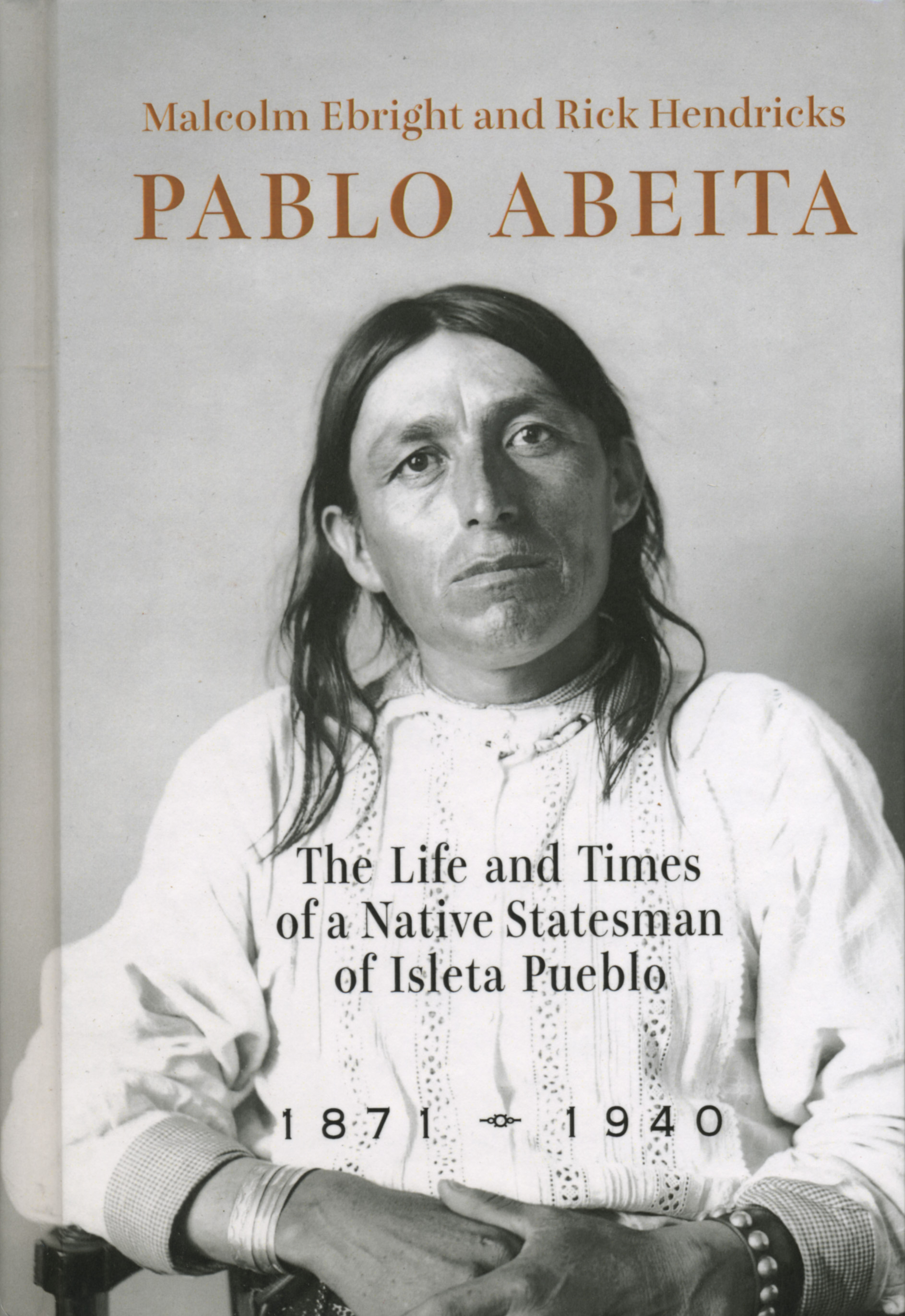
ME-PE Pablo Abeita: The Life and Times of a Native Statesman of Isleta Pueblo, 1871-1940
By Malcolm Ebright and Rick Hendricks
Click on cover for larger view
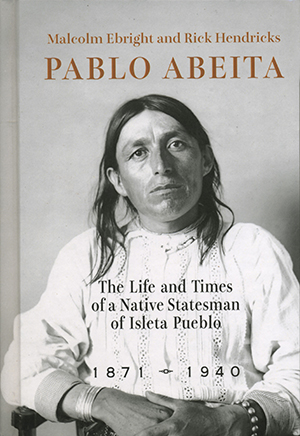
University of New Mexico Press 2023
Now in Paperback 232 pages 6” X 9"
|
This is the first biography of a Pueblo leader, Pablo Abeita, a man considered as the most important Native leader in the Southwest in his day. Pablo Abeita's life in Isleta Pueblo, just south of Albuquerque, was a colorful and important one. Educated in the best schools in New Mexico, Abeita became a strong advocate for Isleta and the other eighteen New Mexico pueblos during the periods of assimilation, boarding schools, and the reform of US Indian policy. Working with some of the most progressive Indian agents in New Mexico, with other Pueblo leaders, and with advocacy groups, he received funding for much-needed projects, such as a bridge across the Rio Grande at Isleta. To achieve these ends, Abeita testified before Congress and was said to have met, and in some cases befriended, nearly every US president from Benjamin Harrison to Franklin D. Roosevelt.
Abeita dealt with many issues that are still relevant today, including reform of US Indian policy, boarding schools, and Pueblo sovereignty. Pablo Abeita's story is one of a people still living on their ancestral homelands, struggling to protect their land and water, and ultimately thriving as a modern pueblo. |
|
|
Click on cover for larger view
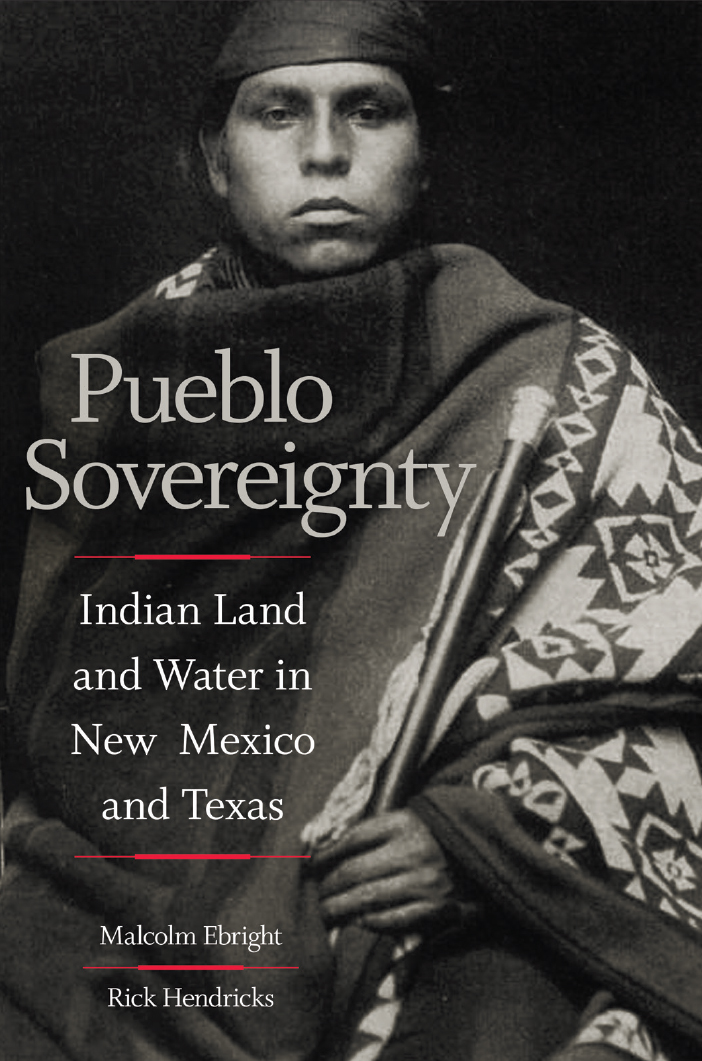
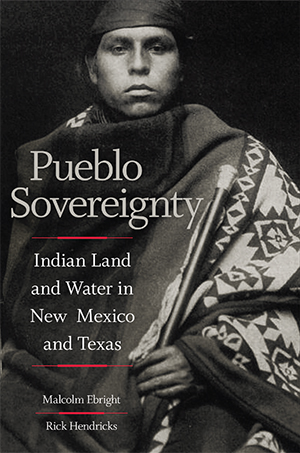
Cover photo: Martin Vigil, Governor Tesuque Pueblo, Chairman of the All Indian Pueblo Council.
|
ME-PS.Pueblo Sovereignty, Indian Land and Water in New Mexico and Texas
By Malcolm Ebright and Rick Hendricks.
Over five centuries of foreign rule — by Spain, Mexico, and the United States — Native American pueblos have confronted attacks on their sovereignty and encroachments on their land and water rights. How five New Mexico and Texas pueblos did this, in some cases multiple times, forms the history of cultural resilience and tenacity chronicled in Pueblo Sovereignty by two of New Mexico’s most distinguished legal historians, Malcolm Ebright and Rick Hendricks. Extending their award-winning work on Four Square Leagues, Ebright and Hendricks focus here on four New Mexico Pueblo Indian communities; Pojoaque, Nambe, Tesuque, and Isleta; and one now in Texas, Ysleta del Sur. Pueblo Sovereignty was recently awarded the Arizona/New Mexico Book Award. A recent review described Pueblo Sovereignty as “an important book for scholars of Native history. It is exhaustively researched and balanced in its analysis and interpretation of the material.”
University of Oklahoma Press 2019
Hardcover and Paper
260 Pages, 6" x 9", 21 B&W
Illustrations, 3 Maps.
|
|
|
Click on cover for larger view
Sale in honor of the 50th Anniversary of the Tierra Amarilla Courthouse Raid, June 5, 1967, which brought the injustices in the history of the Tierra Amarilla Grant to national and international attention.
|
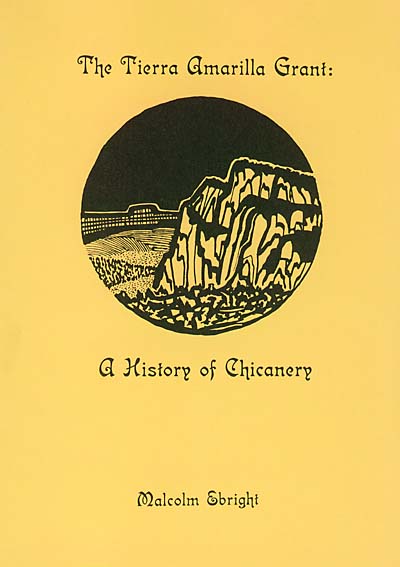
ME-TA. The Tierra Amarilla Grant: A History of Chicanery by Malcolm Ebright. This book contains a brief history of the Tierra Amarilla Grant, with a transcription and translation of the grant documents and a list of the first settlers in the seven communities that make up the Tierra Amarilla area. With a forward by Frank Waters and a photo essay of the Tierra Amarilla communities, this is a perfect commemoration of this revolutionary event that put the land grant issue on center stage in New Mexico.
Malcolm Ebright, The Tierra Amarilla Grant: A History of Chicanery, 66 pages, notes, photos, preface by Frank Waters.
|
|
|
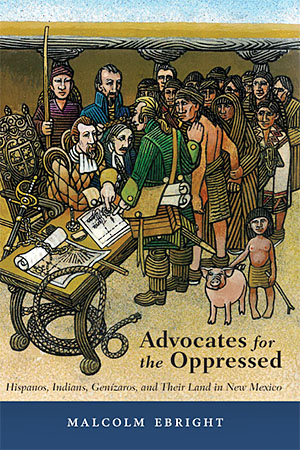 |
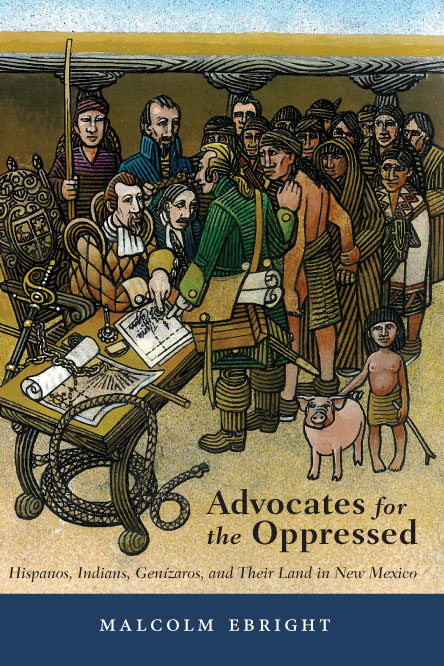
ME-AFTO. Advocates for the Oppressed: Hispanos, Indians, Genízaros, and Their Land in New Mexico by Malcolm Ebright.
Having written about Hispano land grants and Pueblo Indian grants separately, Malcolm Ebright now brings these narratives together for the first time, reconnecting them and resurrecting lost histories. He emphasizes the success that advocates for Indians, GenÃzaros, and Hispanos have had in achieving the return of lost lands and by reestablishing the right to use those lands for traditional purposes. Includes chapters on Zuni Pueblo and Galisteo, San Marcos, Cerrillos, and La Ciénega Pueblo grants. 440 pages, 13 original drawings by Glen Strock, 4 maps, index, bibliography.
Hardcover Sale Price $40
Paperback Sale Price $25
|
|
|
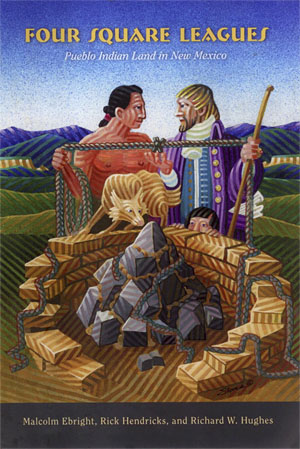
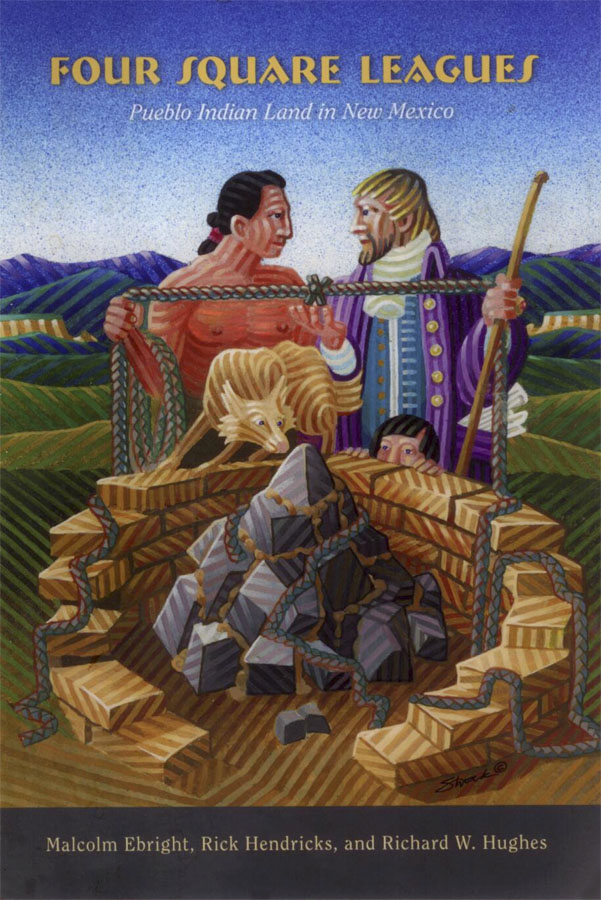
EHH-FSL.Four Square Leagues: Pueblo Land in New Mexico
by Malcolm Ebright, Rick Hendricks, and Richard W. Hughes
This book, described as “an authoritative masterpiece,” with “information that is startlingly new,” is the first up-to-date account of the history of Pueblo Indian land beginning in late 17th century New Mexico. Containing chapters about the origin of the Pueblo league, about the Cruzate documents, and the adjudication of Pueblo lands by U.S. Courts, the book is characterized by success stories as well as the loss of Pueblo land. Specific studies of the land struggles of Jemez, Cochiti, Santa Clara, Sandia, and Picuris Pueblos are capped by Santa Ana Pueblo’s campaign in the early 1700s to buy back their ancestral lands from their Spanish neighbors, and the story of Taos Pueblo’s successful battle for their sacred Blue Lake. 452 pages, 12 original drawings by Glen Strock, 4 maps and 7 illustrations, index, bibliography.
|
|
|
|
|
|
Just off the Press: Paperback Edition of Four Square Leagues, winner of best book award for 2014, Border Regional Library Association and best history book award for 2014 from the Historical Society of New Mexico.
|
Back in
Print: New Edition with New Introduction
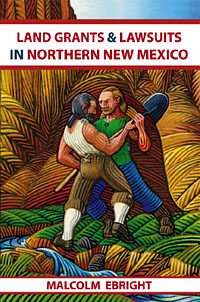
Now Available
in Paperback $20 & in Embosssed Cloth
$35
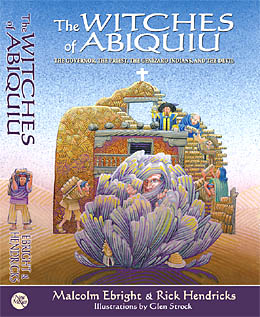
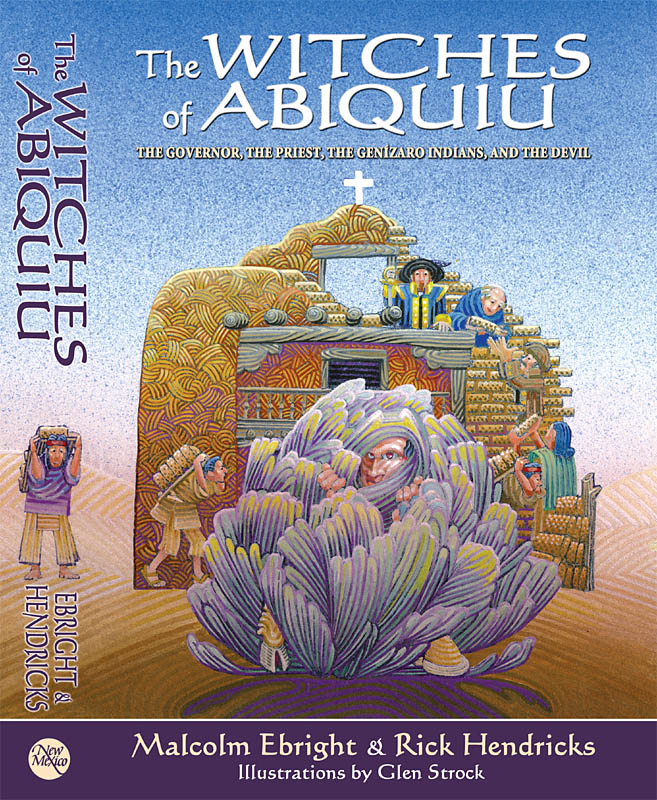
Book by Ebright & Hendricks: UNM Press
Illustrations by Glen
Strock.
The
Witches of Abiquiú:
The Governor, the Priest, the Genízaro Indians, and
the Devil
Available in Paperback for $25.00
Now Order Online with PayPal
-
Pay with Visa, Mastercard, Amex or Check
Just Click on the "Add to Cart" Buttons by Each Book
Listing
ONLINE
RESEARCH TEXT
General
Accounting Office Land Grant Report
New
How
to Research a Land
Grant
54:23 Click on link to access audio
Historians Malcolm Ebright and Richard Salazar of the Center
for Land Grant Studies explain what resources are available
to research each of the more than 300 Land Grants in New
Mexico. Introduced by Faith Yoman of the NM State Library
Southwest Collection. Presented by the NM State Library on
Nov 24, 2009. Recorded and Produced by Cultural
Energy
Land
Grant Database The
Center for Land Grant Studies, with funding from Rio Arriba
County, the New Mexico State Archive,
and
the Chamiza Foundation, has
developed a database of all New Mexico land grants. The
initial version, while not covering every grant, lists some
basic information on each grant, including primary source
references. A preliminary listing of grants entered so far
are shown here:
Grants
A-J |
Grants
L-R |
Grants
S-Z |
Grants
by County
Explanation
of Types of Grants
|
Rio Arriba Grant Summaries
Later
versions, if additional funding is secured, would include
all grants, and may include footnoted summaries of each
grant, links to transcriptions or scans of original grant
documents, translations if available, maps and other
resources. If funding allows, the updated database will be
posted on the Internet at www.southwestbooks.org.
Database
design is by Robin Collier and Malcolm Ebright. Researchers
include Robin Collier, Denise Damico, Malcolm Ebright, Rick
Hendricks, Kay Matthews, Norman Martinez, Richard Salazar,
and Mark Schiller. Additional other resources for the
project are being provided by the New Mexico State Archives.
Some completed grant
summaries, primarily those in Rio Arriba County, may be
purchased
individually on our Land & Water
page.
Land
Grants in a Nutshell.
Complete
notes online. Notes from a lecture by Malcolm Ebright
explaining the essential elements of New Mexico's Land
Grants.
Land
Grant Research Guide
on the New Mexico State Archive Web Site. Lists and
describes what materials are available at the archive in
Santa Fe.
Eugene
Lobato v. Zachary
Taylor
Landmark Ruling after 21 years of litigation on the Sangre
de Cristo grant in San Luis, CO by the
Colorado
Supreme Court, June 24, 2002,
affirming the rights of access
for grazing, firewood and
timber.
On
April 28, 2003 the
court issued an
additional ruling,
directing the trial court to
identify all landowners who have access rights to the Taylor
Ranch and to enter all necessary and appropriate orders to
safeguard those rights. On June 16, 2003, the court
clarified that plaintiffs need only prove by a preponderance
of the evidence that their property is included within the
boundaries of property owned or occupied by settlers during
the time of Gilpin ownership, and that the costs of
determining this must be borne by Taylor. The court suggests
that best evidence of benefited properties conveyed by
Beaubien is the official 1894 Costilla County survey and
inventory of lands held by individuals along the Culebra,
Vallejos, and San Francisco Creeks.
The
Treaty of Guadalupe
Hidalgo.
Complete
text. Includes pictures from the National Archive of the
treaty, the stricken Article
X
and the Protocol
of Querétaro
.
Bibliography
of Land
Grant books.
Glossary
of
Land Grant terms.
Excerpts
from "Land Grants &
Lawsuits"
Complete
sections online. Introduction,
Conclusion
& Index
from the book
by
Malcolm Ebright about New Mexico's land grant communities
and their struggle for justice.
The US
General Accounting Office (GAO) report on the Treaty of
Guadalupe: Definition and List of Community Land Grants in
New Mexico; Exposure Draft. Prepared for the US Senate,
this 49 page report includes an overview, an inventory of
295 Spanish and Mexican land grants in New Mexico and a
bibliography. Download in English
or Spanish
900K PDF files. (Requires Adobe
Acrobat).
The GAO invited comments on this draft to be sent via the
GAO
web page
or by email to landgrants@gao.gov
until April 2, 2001. Public meeting were also held in March,
2001. The final report issued on June 4, 2004 is
here: the
full English pdf version of the
GAO report (3 M File) or the
full Spanish pdf version (3.1 M
File)
RESEARCH
MATERIALS
Genealogical
& Research
Materials
Census, marriage and service records. Indexes of Spanish and
Mexican archives. Family trees for specific families. Useful
in tracing your roots.
Unpublished
Manuscripts
By leading scholars of New Mexico and the Southwest. Not
available anywhere else.
OTHER
RESOURCES
Links
Internet Links to Research Organizations, Government
Resources, Progressive News Sites, Regional Sites & Art
and Cultural Organizations.
Center
for Land Grant Studies
Learn more about the Center and how to support its
work.
Add
your name to our Electronic Mailing
List
Receive
notice of special sales & events. Your name will
not be shared or sold.
Orders
Print
a form to order books and materials by mail.
Contact
Us
How
to contact us about orders.
|
General
Accounting Office Land Grant Report
This much anticipated report was finally issued on June
4, 2004.
Malcolm Ebright, Norman Martinez & Moises Morales
analyze the GAO study in a half interview, broadcast on KRZA
and KDCE, by Mike Tilley of Cultural
Energy. Listen
online to the interview Order
CD or Tape
Other view by David Benivides
from the San Luis Land Grant Conference
Listen
online to this Conference
(selections recorded & produced
by Mike Tilley of
Cultural
Energy & broadcast
on KRZA) which also covers the victory on Sangre de Cristo
Land grant and related issues
Another view on the GAO
report is from the The New Mexico Land Grant Forum
and the Mexicano Land Education and Conservation Trust
Malcolm Ebright, Director of the Center for Land Grant
Studies,
has written a response that was published in the La
Jicarita News entitled:
by Malcolm Ebright
"After four years of "work" the General Accounting Office
has spoken... "
more... Click
here to read Malcolm Ebright's full
response.
" ...The first e-mail reaction I received to the report
was: "It's a whitewash." I would go further: the report is a
slap in the face..."
" ... The G.A.O. report is neither independent, unbiased,
nor objective. It is, rather, a partisan brief for the
government, explaining, as the government has been trying to
explain since land grants were first "adjudicated" by the
Surveyor General of New Mexico in 1854, why these
"adjudications" were fair. In fact, they were often not fair
by any standard. ... "
"... Because it is so partisan, the G.A.O. report does
not deserve to be taken seriously as historical scholarship
or as fair-minded legal analysis. The G.A.O. report is a
slap in the face because it sidesteps the issues and still
expects that scholars, lawyers, and land grant heirs and
residents will actually like the report. The essence of the
G.A.O. report is: here are the court decisions regarding the
adjudication of land grants in New Mexico. These decisions
say that the process was fair and the U.S. met its
responsibility under the Treaty of Guadalupe Hidalgo. The
G.A.O. agrees without doing any independent analysis. End of
story.
But this is not the end of the story. New Mexicans
interested and involved in the land grant question are more
dedicated and more sophisticated than these Washington
lawyers. They have read and understand the research and land
grant histories that have been written and continue to be
written. They have worked this land, plowed it, irrigated
it, planted it, weeded it, harvested it, and then gone to
meetings in the evening about whether they owned it, or
whether they will retain their water rights to irrigate it.
They have grazed their cattle on it and gathered wood,
herbs, and other important resources from it. They can see
behind the legal niceties that in their hard-hearted
application by the G.A.O. squeeze the life out of something
they hold sacred. They and their ancestors know that this
land was promised them by the Treaty of Guadalupe Hidalgo
and has been lost because of unfair actions by the U. S.
government. This is not the end of the story."
more... Click
here to read Malcolm Ebright's full
response.
Click here for the full
English pdf version of the GAO report (3 M File)
or here for the full Spanish
pdf version of the GAO report (3.1 M File)
Both pdf files require Adobe
Acrobat
For those with slow internet connections here is
a Plain Text version (49 K)
of just the Executive Summary and Results in Brief and
Principal Findings
|